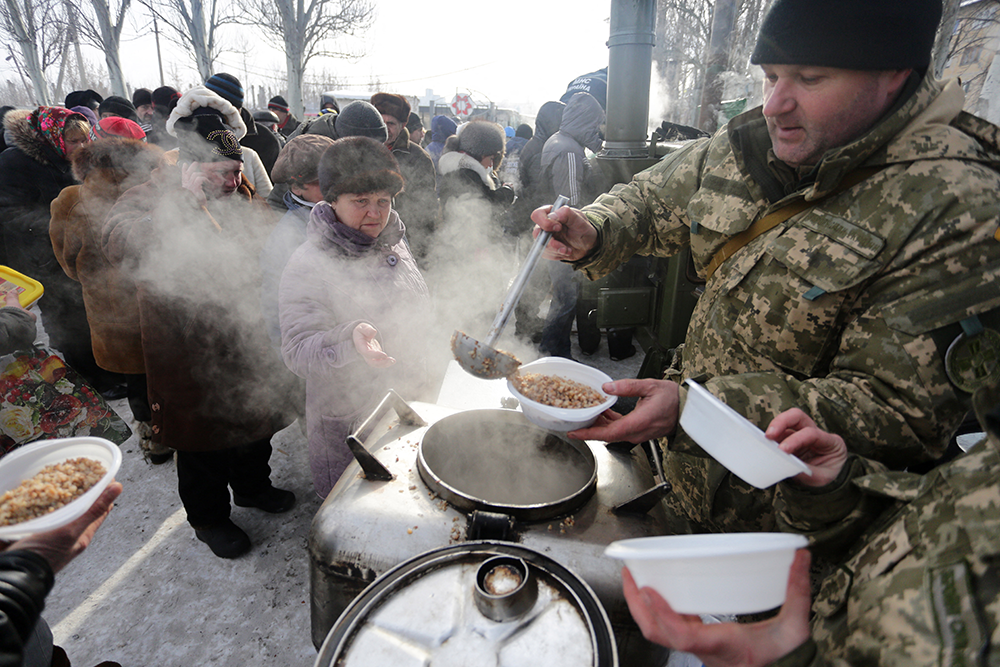
乌克兰平民的忍耐极限究竟在哪里?在近四年的无情战乱中,乌克兰人民饱受即决处决、无人机在城市街道上猎杀民众的“无人机狩猎”以及成群无人机和导弹对城市的持续轰炸之苦。今年冬天,随着俄罗斯军队系统性地瘫痪乌克兰能源基础设施的行动达到顶峰,他们惊人的韧性面临前所未有的严峻考验。
过去三个冬天,弗拉基米尔·普京都曾试图通过让乌克兰城市陷入黑暗和严寒来使其无法居住,但均以失败告终。然而这一次,克里姆林宫将冬季武器化的行动似乎即将得逞。随着乌克兰气温降至零下16摄氏度,俄罗斯军队正竭尽全力瘫痪尽可能多的城市供暖系统。过去一周,俄罗斯对乌克兰发动了前所未有的轰炸,出动了近1100架无人机、890枚制导炸弹和50多枚导弹,其中包括“奥列什尼克”高超音速导弹,在严寒天气下袭击发电厂和民宅。弗拉基米尔·泽连斯基称这些袭击是“冷酷的恐怖主义”,旨在造成平民苦难,导致1000多栋建筑失去供暖。自圣诞节以来,俄罗斯的袭击已使敖德萨、苏梅、第聂伯罗、哈尔科夫、日托米尔和扎波罗热等城市以及基辅及其郊区的大片地区停电超过一天。
普京此次袭击之所以如此有效,是因为一个基本但不可阻挡的物理定律——水结冰时体积会膨胀约10%,导致管道和供暖系统开裂,而这些损坏要等到春天才能修复。为了避免基辅的基础设施遭受不可挽回的损失,市长维塔利·克利奇科上周宣布,将排干市内许多公寓楼的管道和供暖系统。他建议受影响的居民在房屋无法居住期间“暂时”撤离。克利奇科充满斗志地表示:“乌克兰人民不断证明,即使在最黑暗的时刻,意志力也能转化为韧性。我们团结一致,坚不可摧。”
然而,一月份最严酷的天气将对乌克兰人的意志力进行极限考验。与前三个异常温暖的冬季不同,今年的冬天异常寒冷。“我刚走到外面,就感觉冷得要命,”博主安吉莉卡·沙拉吉娜写道。 “说实话,我真不记得基辅的冬天是这样的。”
乌克兰政府在城市公园和林荫大道上搭建了一系列配备暖气和隔热设施的帐篷,称为“无敌点”,人们可以在那里取暖、给手机充电、喝热汤,还能得到专业心理咨询师的帮助。但当俄罗斯的袭击导致供水、供电、供暖系统和公共交通瘫痪时,城市就几乎无法继续居住了。“从清晨开始,我就给朋友们打电话,问他们昨晚过得怎么样,”泽连斯基的前新闻秘书尤利娅·门德尔说,“俄罗斯的无人机和导弹每次袭击都给民众带来更大的伤害——乌克兰根本无法应对。”
许多乌克兰人正面临着一个痛苦的选择:流亡海外是否比留在乌克兰更容易忍受。早在9月,德国外交部高级官员就警告柏林联邦政府,要做好准备迎接新一波乌克兰难民涌入,这些难民因普京残酷的冬季战争战略而被驱逐出家园。波兰和捷克共和国已制定应急计划,并调整了援助体系,以应对可能出现的新一波大规模难民涌入。欧盟也已将乌克兰人的临时保护指令延长至明年3月。据乌克兰国家边防局统计,截至今年第一周,乌克兰边境的客运量增长了约27%。
制造新一波乌克兰难民潮是克里姆林宫的目标。二战期间,盟军军事策划者曾用“驱逐敌方人口”一词来为轰炸德国城市辩护——这一战略至今仍是战争中最具争议的战略之一。普京似乎正试图达到同样的效果。他的计划是出于政治目的,旨在向欧洲各国首都施压,迫使它们同意按照他的条件结束战争。
欧盟面临的问题是,针对乌克兰难民的反弹情绪日益高涨。德国收容了124万乌克兰难民,是欧洲收容乌克兰难民最多的国家,但德国去年大幅削减了乌克兰难民的福利。波兰总统卡罗尔·纳沃罗茨基否决了一项旨在将乌克兰公民保护期限延长至今年的修正案。华沙市长拉法尔·特扎斯科夫斯基提议削减父母不在波兰工作的乌克兰家庭的儿童福利,理由是“常识和简单的经济学原理”,以及来自“街头普通波兰人”的压力。荷兰政府也表示,计划帮助难民“返回乌克兰”。
在战争初期,约有430万乌克兰人逃离家园,欧洲对他们的热情接纳堪称史诗级的慷慨与团结的典范,体现了人道主义和政治层面的团结。成千上万的普通英国人敞开家门,接纳流离失所的乌克兰人,而来自政治光谱中那些通常对大规模移民持敌对态度的群体几乎没有提出任何反对意见。但四年过去了,几乎所有欧洲国家(英国除外)现在都出现了反对向乌克兰提供更多援助、主张妥协以尽快结束战争的主要政党。在匈牙利、捷克、斯洛伐克和克罗地亚,这些对泽连斯基持怀疑态度的政党执政——而波兰、比利时、意大利和奥地利政府也都以不同的方式表达了反对继续支持基辅的战争行动以及没收俄罗斯国有资产的立场。
新一波乌克兰难民潮可能会进一步加剧欧洲本已捉襟见肘的预算和容忍度,并带来新的政治压力。普京驱逐乌克兰民众的策略可谓是极其阴险狡诈。但这一策略可能会非常有效地让欧洲人关注这场战争造成的人员伤亡,以及如何尽快结束这场战争。
What is the limit of Ukrainian civilians’ endurance? In nearly four years of relentless war, Ukraine’s people have faced summary executions, ‘drone safaris’ where unmanned aerial vehicles hunt people down city streets and constant bombardment of cities by swarms of drones and missiles. This winter their remarkable resilience faces its severest test yet as Russian forces reach a tipping point in their systematic attempt to knock out the country’s energy infrastructure.
In each of the past three winters, Vladimir Putin has attempted to render Ukraine’s cities uninhabitable by plunging them into darkness and cold, without success. But this time it looks like the Kremlin’s campaign to weaponise winter may be succeeding. With temperatures in Ukraine falling to -16°C, Russian forces are trying to knock out as many citywide heating systems as possible. Over the past week, Russia hit Ukraine with an unheard-of bombardment of nearly 1,100 drones, 890 guided bombs and more than 50 missiles, including the Oreshnik hypersonic missile, targeting power plants and homes during brutal cold. Volodymyr Zelensky called the attacks ‘cynical terror’ aimed at civilian suffering, with more than 1,000 buildings losing heat. Since Christmas, Russian attacks have blacked out the cities of Odesa, Sumy, Dnipro, Kharkiv, Zhitomir and Zaporizhia for more than a day, along with swaths of Kyiv and its suburbs.
The reason Putin’s latest attacks are particularly effective is a basic but inexorable law of physics – water expands by about 10 per cent when it freezes, cracking pipes and heating systems that cannot then be repaired until spring. In an attempt to pre-empt irreparable damage to Kyiv’s infrastructure, the city’s mayor, Vitali Klitschko, announced last week that the plumbing and heating systems of many of the city’s apartment buildings would be drained of water. He advised affected residents to ‘temporarily’ evacuate the city while their homes were uninhabitable. ‘The Ukrainian people continue to demonstrate that willpower becomes resilience, even in the darkest moments,’ was Klitschko’s defiant message. ‘Together, we are unbreakable.’
But the hardest January weather will test Ukrainians’ willpower to the utmost. Unlike the previous three unusually mild winters, this one is polar. ‘I just stepped outside and it’s insanely cold,’ reports the blogger Angelica Shalagina. ‘I honestly don’t remember winters like this in Kyiv.’
Ukraine’s government has organised a network of heated insulated tents in city parks and boulevards known as ‘Points of Invincibility’, where people can warm up, charge their phones, drink hot soup and receive support from trained psychologists. But there is a point where cities cease to be practically liveable, as Russian attacks shut down water and electricity supply, heating systems and public transport. ‘From early morning, I’m calling my friends to ask how they are after a terrible night,’ says Iuliia Mendel, Zelensky’s former press secretary. ‘Russian drones and missiles hit the population harder with every strike – something Ukraine isn’t able to cope with.’
Many Ukrainians are facing an agonising choice over whether a flight into exile could be a more bearable proposition than remaining. As early as September, senior German foreign ministry officials were warning the federal government in Berlin to brace for a fresh influx of Ukrainian refugees, pushed out of their homes by Putin’s ruthless winter war strategy. Poland and the Czech Republic have made contingency plans and adapted their support systems in case of a new large influx of refugees. The EU has also extended the Temporary Protection Directive for Ukrainians until March next year. As of the first week of this year, passenger traffic across the Ukrainian border had grown by approximately 27 per cent, according to the State Border Guard Service of Ukraine.
Generating a new wave of Ukrainian refugees is the Kremlin’s aim. Allied military planners during the second world war used the term ‘de-housing the enemy population’ as a justification for the area bombing of German cities – a strategy that remains one of the most controversial of the war. Putin, it seems, is attempting to produce the same effect. His agenda is political, intended to put pressure on European capitals and force them to agree to ending the war on his terms.
The problem for the EU is that there is already a growing backlash against Ukrainian refugees. Germany, which hosts 1.24 million Ukrainians, the most of any European country, introduced significant benefit cuts last year. Poland’s President Karol Nawrocki vetoed an amendment that would have extended protection for Ukrainian citizens into this year, while Warsaw’s mayor, Rafal Trzaskowski, proposed cutting child benefits for Ukrainian families where parents do not work in Poland, citing ‘common sense [and] simple economics’ as well as pressure from ‘ordinary Poles on the street’. And the Dutch government has stated that it is planning to help refugees ‘move back to Ukraine’.
Europe’s extraordinary welcome of the estimated 4.3 million Ukrainians who fled in the early months of the war was an epochal lesson in generosity and solidarity, human and political. Thousands of ordinary Britons opened their homes to displaced Ukrainians with remarkably little pushback from parts of the political spectrum otherwise hostile to mass immigration. But four years on, almost every European country (with the notable exception of Britain) now has a major political party that opposes more aid to Ukraine and advocates compromise in order to bring a swift end to the war. In Hungary, Czechia, Slovakia and Croatia, these Zelensky-sceptic parties are in power – while the governments of Poland, Belgium, Italy and Austria have all in different ways expressed opposition to continued support for Kyiv’s war effort and confiscating Russian state assets.
A new wave of Ukrainian refugees is likely to stretch already tight European budgets and tolerance, as well as cause new political pressures. Putin’s strategy of de-housing Ukraine’s population is fiendishly cynical. But it is a strategy that could prove devastatingly effective in focusing European minds on the human cost of this war – and on how to end it as soon as possible.