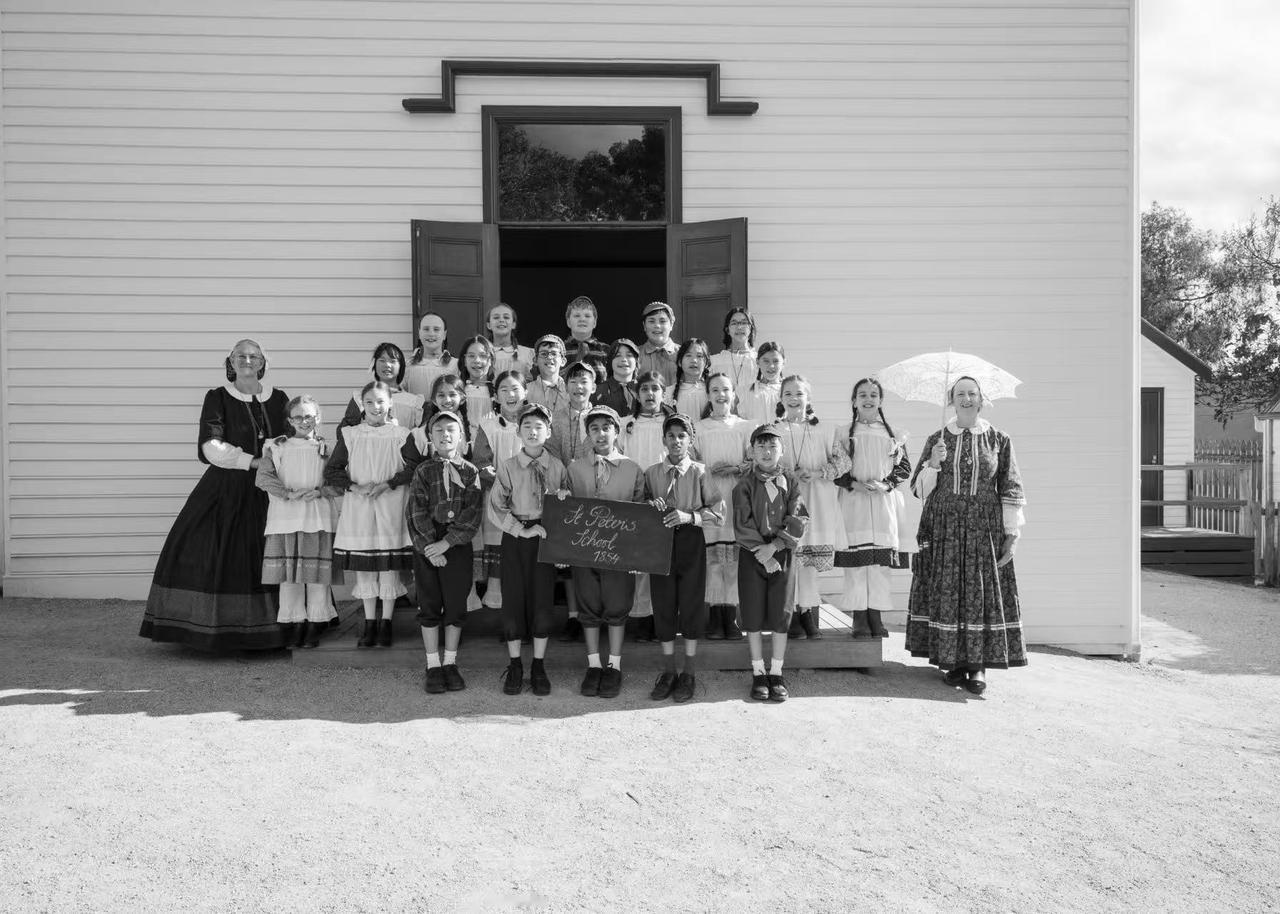
This photo captures a Victorian-era themed campus activity held at St Peter's School in Australia. The number 1854 on the blackboard indicates the historical era being reenacted.
The background features a simple wooden school building withic 19th-century Australian colonial style, complete with white wall panels and symmetrical doors and windows. The marking "St Peter's School 1854" on the blackboard highlights the activity’s aim to revisit the school’s history and recreate the campus scene of 1854.
Around twenty students and two female teachers appear in the picture, all wearing authentic Victorian-style costumes. Girls are in long dresses with white pinafores, while boys wear shirts, waistcoats and knickerbockers, and some put on top hats, restoring the student attire of that period. One teacher wears a dark long dress, and the other holds a parasol in a floral long dress, fitting the dressing customs of women at that time. The unified outfits and black-and-white tone create a strong vintage and historical ambiance.
Immersive historical activities like this are prevalent in Australian education, enabling students to experience colonial-era campus life, costumes and education modes firsthand.
Located in Melbourne, Camberwell Primary School ranks 10th among over 5,000 public primary schools across Australia. It has organized three-day two-night camping and historical experience activities for students from Grade Three every year. These events are usually held in an 18th-century gold-mining town in Victoria, the heart of Australia’s 19th-century gold rush.
Combined with local history, such immersive activities turn abstract textbook knowledge into vivid real-life experiences. By dressing in vintage clothes and simulating ancient daily life, students can easily grasp historical details and learn about the life of predecessors. This engaging educational method works much better than pureroom teaching.