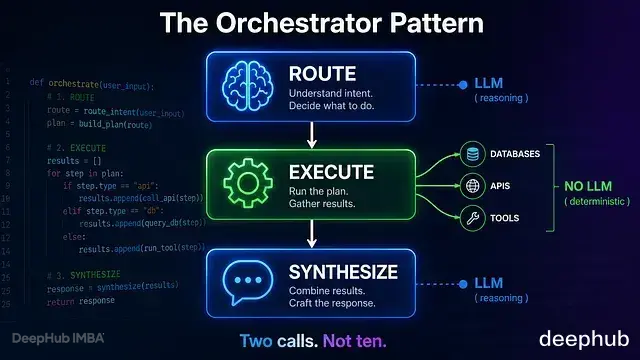
一个简单的agentic loop就是一个 while 循环,LLM 在其中决定做什么、执行工具、观察结果、再做决定。
这模式能用是可以用的不过有个最大的问题,就是费钱:
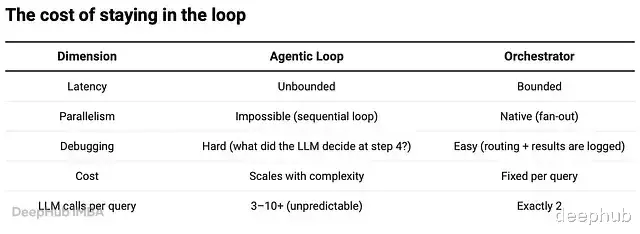
一个三 agent 查询要是用 agentic loop那么7 次 LLM 调用,4.2 秒,0.12 美元。如果用 orchestrator的话 2 次 LLM 调用,1.1 秒只要0.03 美元。同样的 agent同样的答案,却便宜 70%。
循环每转一圈就是一次 LLM 调用。每次调用多花 300-800ms 延迟和钱。简单的"调 check_greeting,再调 handle_hi",两次 LLM 路由没问题,但是
为单个答案并行调三个 agent
执行顺序计划,步骤 2 依赖步骤 1
在生产中扛每秒几百个请求
agentic loop 就撑不住了。LLM 卡在每次决策的关键路径上,每次决策都会延迟。
所以,最简单的方法就是,让 LLM 只规划一次然后不靠它执行
Orchestrator 模式只需要两次调用,不是十次整个架构三步:
User Query ↓ [STEP 1: ROUTE] ← 一次 LLM 调用:"哪些 agent 来处理?" ↓ [STEP 2: EXECUTE] ← 无 LLM:确定性调用 agent ↓ [STEP 3: SYNTHESIZE] ← 一次 LLM 调用:"把结果写成好答案" ↓ Final Answer
LLM 两请求——一次定计划,一次写答案。中间全是应用代码在跑。没有循环,也没有不确定性,没有"LLM 会不会又调一个工具?"这样的问题。
一个处理三种查询类型的 orchestrator大概如下:
单 agent——"当前系统指标?"→ 路由到一个 agent
并行扇出——"给我指标和趋势分析"→ 同时调两个 agent
顺序 DAG——"检查异常,有则拉配置"→ 按依赖顺序调 agent
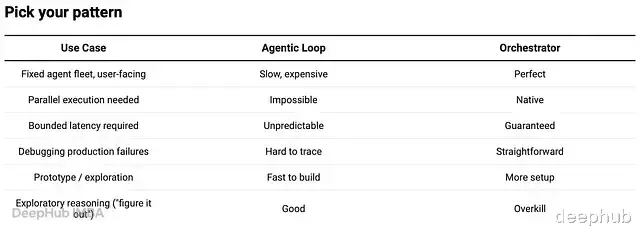
同样的 agent同样的工具,但 LLM 只做一次路由决策,剩下全是应用执行。
Agent 注册表作为发现协议Agent 用一个简单的字典注册能力。不需要发现协议——你自己部署的 agent,你知道它们能做什么:
REGISTRY = { "data_agent__get_report": { "agent": "Data Agent", "description": "Fetch the latest report for a given entity", "execute": get_report, }, "analytics_agent__get_trends": { "agent": "Analytics Agent", "description": "Get historical trends and anomaly detection", "execute": get_trends, }, "config_agent__check_config": { "agent": "Config Agent", "description": "Check system configuration for a given component", "execute": check_config, }, }
线上部署时注册表放在 Redis 或数据库里,agent 通过 HTTP POST 注册。模式一样——技能名到执行函数的查找表。
LLM 把 agent 看成工具定义(JSON schema),但关键在第四个元工具:
{ "name": "plan_execution", "description": "Use this ONLY when the query requires sequential steps " "where a later step DEPENDS on the result of an earlier step.", "parameters": { "properties": { "reason": {"type": "string"} }, "required": ["reason"] }, }
plan_execution 不调任何 agent——它什么都不做。它是一个信号不是函数。LLM 选中它时,orchestrator 知道该切到顺序模式了。一次 LLM 调用、一组工具选择、三种执行策略——单 agent、并行、顺序——全由返回的工具决定。
第一步:一次 LLM 调用统管的路由器路由器用 temperature=0.0(确定性)做一次 LLM 调用。LLM 唯一的工作是选工具。明确告诉它不要回答问题。
SYSTEM_PROMPT = """You are a query router. Your ONLY job is to decide which tool(s) to call. Rules: - If the query needs ONE agent, call that one tool. - If the query needs MULTIPLE INDEPENDENT agents, call all of them. - If the query needs steps IN ORDER, call plan_execution. Do NOT answer the user's question — just pick tools."""
单次调用:
response = client.chat.completions.create( model=deployment, messages=[{"role": "system", "content": SYSTEM_PROMPT}, {"role": "user", "content": query}], tools=TOOL_DEFINITIONS, tool_choice="auto", temperature=0.0, )
整个路由逻辑非常简单
tool_names = [tc.function.name for tc in reply.tool_calls] if "plan_execution" in tool_names: → mode = "sequential" elif len(tool_names) == 1: → mode = "single" else: → mode = "parallel"
LLM 返回结构化的工具调用,一个工具→单 agent。多个工具→并行。plan_execution 元工具→顺序。一次调用,三种策略。
第二步:不需要 LLM的执行器这是 orchestrator 真正省成本的地方。执行器是纯 Python——没有 LLM、没有不确定性、没有延迟炸弹。三种模式:
Single——直接跑 agent:
result = REGISTRY[tool_name]["execute"]()
Parallel——同时跑所有 agent:
with concurrent.futures.ThreadPoolExecutor() as pool: futures = {name: pool.submit(REGISTRY[name]["execute"]) for name in tool_names} results = {name: f.result() for name, f in futures.items()}
Sequential——按顺序跑,传递上下文:
for step in plan: results[step["tool"]] = REGISTRY[step["tool"]]["execute"]()
零 LLM 消耗,所以线上部署时换成 asyncio.gather 加 HTTP 调用就行。
路由之后系统就和其他微服务编排没区别。延迟可预测,调试直来直去,可观测性用标准工具就够。"AI"被压到两层(路由和合成)里,中间全是确定性的执行,也方便调试。
第三步:润色答案的合成器Agent 输出的是 JSON,用户要的是自然语言。再来一次 LLM 调用把数据转成响应:
response = client.chat.completions.create( model=deployment, messages=[ {"role": "system", "content": "Summarize the agent results into a clear, helpful answer."}, {"role": "user", "content": f"User asked: {query}\nResults: {json.dumps(results)}"}, ], temperature=0.7, )
注意路由用 0.0、合成用 0.7是因为路由要精确,合成要可读。不同的工作所以需要不同参数。
三种查询,三种模式完整管道就三个函数调用:
decision = route_query(client, deployment, query) # LLM 调用 1 results = execute(decision) # 无 LLM answer = synthesize(client, deployment, query, results) # LLM 调用 2
查询 1——Single:"当前系统指标?"→ 路由器选 data_agent__get_report → 执行器调它 → 合成器写摘要。
查询 2——Parallel:"给我指标和趋势分析"→ 路由器选两个 agent → 执行器_同时_调 → 合成器合并结果。
查询 3——Sequential:"检查异常,有则拉配置"→ 路由器选 plan_execution → 执行器先跑 analytics 再跑 config → 合成器解释链条。
同一个管道,三种执行策略,始终是两次 LLM 调用。
Agentic loop 把 LLM 同时当大脑和手——每步既决策又执行。Orchestrator 把两者拆开:
LLM = 大脑 → 定计划(一次调用)
应用 = 手 → 执行计划(确定性)
LLM = 嘴 → 解释结果(一次调用)
这套分离就是 orchestrator 能扩的原因。"大脑"(路由)可以缓存——相同查询在 temperature=0.0 下始终走相同路由。"手"(执行)就是 HTTP 调用。"嘴"(合成)是唯一的创造步骤。线上场景里,API 消费者如果要原始 JSON,连合成那一步都能省——压到每个请求一次 LLM 调用。
所以Agentic loop 适合前期的探索工作,而Orchestrator 适合生产。
https://avoid.overfit.cn/post/8c270e259b2a4172ac95d38d9ab68211
by Amogh Ubale