本问将覆盖 API 的每个核心部分:定义模型、约束字段、写验证器、组合嵌套结构、控制序列化。所有示例基于 Pydantic v2 和 Python 3.10+,每个清单完整可运行。
用 BaseModel 定义模型Pydantic 的核心就是 BaseModel。继承 BaseModel,用注解声明字段。Pydantic 在类创建时检查注解、构建校验 schema,每次实例化时用它。
无默认值的就是必填。有默认值或声明为 T | None 且默认 None 的就是可选。
from pydantic import BaseModel class Address(BaseModel): street: str city: str state: str zip_code: str country: str = "US" # 可选,默认 "US" apartment: str | None = None # 可选,默认 None addr = Address( street="123 Main St", city="Springfield", state="IL", zip_code="62704", ) print(addr) # street='123 Main St' city='Springfield' state='IL' zip_code='62704' country='US' apartment=None
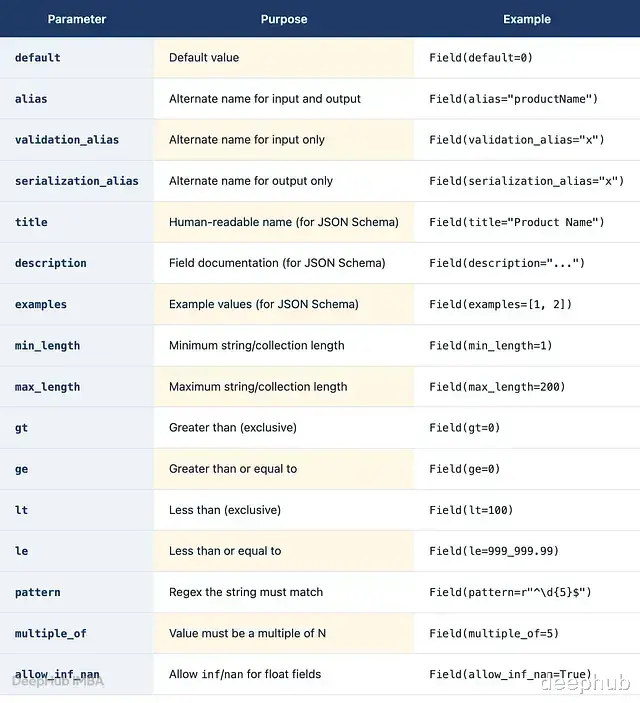
注解加默认值不够用时上 Field()。给字段附加元数据、约束和文档。
from pydantic import BaseModel, Field class Product(BaseModel): name: str = Field(min_length=1, max_length=200, title="Product Name", description="商品显示名称", examples=["Widget Pro"]) sku: str = Field(pattern=r"^[A-Z]{2,4}-\d{4,8}$", description="库存单位,格式 'XX-0000'", examples=["WP-12345"]) price: float = Field(gt=0, le=999_999.99, description="美元价格,必须为正") quantity: int = Field(default=0, ge=0, description="库存数量,不可为负") category: str = Field(validation_alias="product_category", description="来自目录系统的产品类别") product = Product(name="Widget Pro", sku="WP-12345", price=29.99, quantity=150, product_category="Electronics") print(product.category) # Electronics
设了 validation_alias 后,Pydantic 只接受别名作为输入。想同接收字段名需要加 model_config = ConfigDict(populate_by_name=True)。
Annotated 风格复用约束
from typing import Annotated from pydantic import BaseModel, Field PositiveInt = Annotated[int, Field(gt=0)] ShortStr = Annotated[str, Field(min_length=1, max_length=100)] class Widget(BaseModel): quantity: PositiveInt name: ShortStr
两种风格校验行为相同,跨模型共享类型时用 Annotated。
类型强制转换与严格模式,默认宽松模式:兼容类型自动转,不拒绝。这对 JSON 这种全部是字符串时很实用。
event = Event(name="PyCon", attendees="500", event_date="2025-05-15") # "500" 自动转 int,"2025-05-15" 自动转 date
模型级严格模式:设 model_config = ConfigDict(strict=True)。字段级严格模式:Field(strict=True) 或 Annotated[int, Strict()]。
数据源已是强类型(内部 Python 调用、强类型数据库驱动)时用严格模式。解析 JSON 或表单数据时保持宽松。
验证器:field_validator 和 model_validatorPydantic 内置类型系统和 Field() 约束覆盖了大部分校验需求。不够时也可以上自定义验证器。
@field_validator 有四种模式:
mode='after'(默认):内置换完才跑,收到的是已解析的带类型值。
mode='before':在内置校验前跑,收原始输入。
mode='wrap':包裹内置校验,可做日志或错误转译。
mode='plain':完全替代内置校验。
class User(BaseModel): username: str = Field(min_length=3, max_length=30) email: str @field_validator("username", mode="before") @classmethod def normalize_username(cls, v: object) -> str: if not isinstance(v, str): raise ValueError("Username must be a string") return v.strip().lower() @field_validator("email", mode="after") @classmethod def validate_email_domain(cls, v: str) -> str: if "@" not in v: raise ValueError("Invalid email: missing '@'") return v
mode='before' 先跑,去掉空白后的值 "alice_99" 才是 Pydantic 检查 min_length=3 的对象。
验证依赖多字段时用 @model_validator:
class DateRange(BaseModel): start: date end: date label: str | None = None @model_validator(mode="after") def check_start_before_end(self) -> DateRange: if self.start >= self.end: raise ValueError(f"'start' ({self.start}) must be before 'end' ({self.end})") return self
After 模式验证器必须 return self,忘掉就返回 None,对不可空字段会报错 ValidationError。
mode='before' 模型验证器时类方法,收原始数据,能在任何字段校验前重塑输入:
class Coordinate(BaseModel): x: float y: float @model_validator(mode="before") @classmethod def accept_tuple(cls, data: object) -> object: if isinstance(data, (list, tuple)) and len(data) == 2: return {"x": data[0], "y": data[1]} return data print(Coordinate.model_validate((3.0, 4.0))) # x=3.0 y=4.0
ValidationInfo 验证上下文info.context 能把每次调用的数据(如用户权限级别)传进验证器,不用加到模型本身:
class Discount(BaseModel): price: float discount_pct: float @field_validator("discount_pct", mode="after") @classmethod def cap_discount(cls, v: float, info: ValidationInfo) -> float: max_discount = (info.context or {}).get("max_discount", 50.0) if v > max_discount: raise ValueError(f"Discount cannot exceed {max_discount}%") return v Discount.model_validate( {"price": 100.0, "discount_pct": 30.0}, context={"max_discount": 20.0}, )
自定义序列化器@field_serializer 控制导出格式:
class LogEntry(BaseModel): message: str timestamp: datetime @field_serializer("timestamp") def serialize_timestamp(self, v: datetime) -> str: if v.tzinfo is None: v = v.replace(tzinfo=timezone.utc) return v.astimezone(timezone.utc).strftime("%Y-%m-%dT%H:%M:%SZ")
嵌套模型与递归结构一个模型直接作为另一个模型字段的类型注解,天然嵌套:
class Employee(BaseModel): name: str title: str employee_id: int = Field(gt=0) class Department(BaseModel): name: str head: Employee members: list[Employee] = [] class Company(BaseModel): name: str founded: int departments: list[Department]
每个嵌套 dict 针对对应模型校验。Bob 的 employee_id 传 "not_a_number",错误会指到 departments -> 0 -> members -> 0 -> employee_id。
自引用模型用 from __future__ import annotations:
class TreeNode(BaseModel): value: str children: list[TreeNode] = []
model_dump 和 model_dump_json这俩有三种输出方法:
model_dump() 出原生 Python 类型的 dict。
model_dump(mode='json') 出 JSON 兼容值。
model_dump_json() 直接出 JSON 字符串,绕过 json.dumps() 更快。
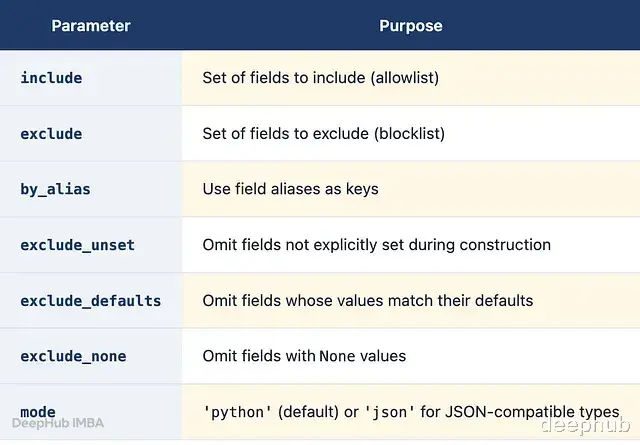
支持 exclude_unset、exclude_none、include、exclude_defaults 等过滤参数。
输入方面:model_validate() 解析 dict,model_validate_json() 解析原始 JSON 字符串,直接调 Rust 核心更快。
三种别名:alias(输入输出都用)、validation_alias(仅输入)、serialization_alias(仅输出)。AliasPath 和 AliasChoices 支持嵌套访问和多个候选名。
model_dump() 和 model_dump_json() 都接受相同的过滤参数:
Item.model_json_schema() 输出 JSON Schema,Field() 里的 title、description、examples、约束全自动流入。
Pydantic Dataclasses 和 TypeAdapterPydantic dataclasses 和 BaseModel 一样支持验证器和约束,但没有 model_dump() 等方法。序列化需通过 TypeAdapter 包装。
TypeAdapter 不需要模型类就能验证独立类型:
int_list_adapter = TypeAdapter(list[int]) int_list_adapter.validate_python(["1", "2", "3"]) # [1, 2, 3] int_list_adapter.validate_json('[4, 5, 6]') # [4, 5, 6]
适合:验证函数参数、验证集合类型、为 API 类型生成 JSON Schema。
总结最后用一些FAQ结束这篇文章:
field_validator 还是 model_validator? 单字段用 @field_validator,精确、快。需要同时访问多个字段时用 @model_validator(mode='after')。
BaseModel 和 @dataclass 的区别? BaseModel 全功能。@dataclass 用熟悉语法但不带模型方法,序列化需 TypeAdapter。
如何让字段可选带默认值? field: str = "default" 或 field: str | None = None。
不建模型怎么验证 JSON? TypeAdapter(list[int]).validate_json('[1,2,3]')。
传了别名验证器不跑? validation_alias 默认只吃别名。加 ConfigDict(populate_by_name=True)。
https://avoid.overfit.cn/post/04f8ff4a442640cc9b2ca1a57fa7c2e7
by ez7